WILDLIFE VOLUNTEERING: THE RED FLAGS MOST PEOPLE MISS
Get the free guide
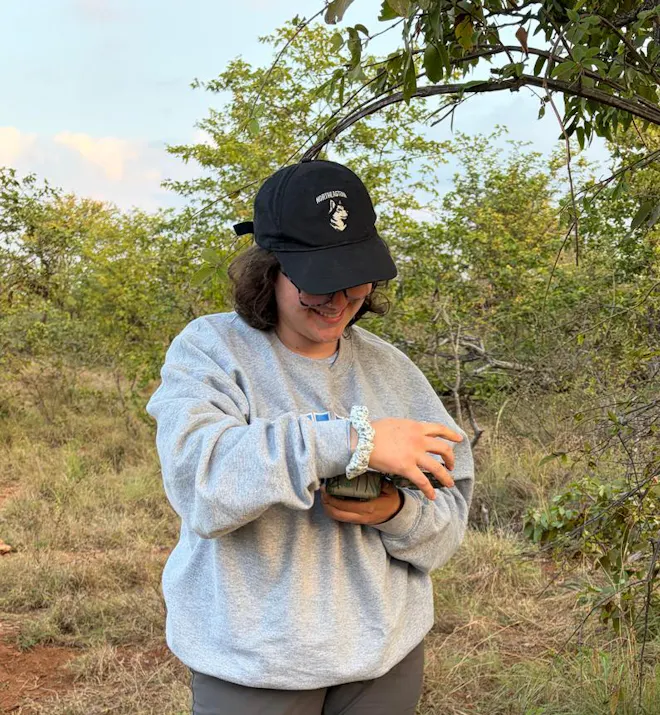
Before I even reached the project, I knew this experience was going to be special. Meeting the other volunteers over breakfast before we'd even set off set the tone for the sense of togetherness throughout my time there.
Everyone, no matter how old they are, what job they're in, if they're in this industry professionally or not, everyone was just very excited to be there.
Working in the field of environmental science and conservation, I rarely get to meet people who volunteer purely because they love it. Being able to listen to the other African Conservation Experience (ACE) volunteers talk about the whole range of projects they were heading to was fantastic. Hearing why a physics teacher chose to spend his time in South Africa, or why someone on sabbatical needed a break from their career, was genuinely affirming. Everyone was travelling for a different reason, and that mix of motivations made the whole experience richer from the very start.
Joining the Umsele Wildlife Research Internship for three weeks was one of the greatest learning experiences I've had. The monitoring work we did, whether it was camera trapping, tracking, large carnivore monitoring, or bird surveys, feeds directly into the Balule reserve's data, and that data goes on to secure funding and shape decisions on the ground. You so often hear about the failures in conservation, the poaching, the habitat loss, but so rarely about the successes. Being at Umsele meant getting to be part of one of those successes, and to see, first-hand, how the small pieces of wildlife monitoring and data collection add up to something that genuinely matters!
What excited me most was being part of something at such a grassroots level.
One of my biggest takeaways from Umsele was seeing what real coexistence between humans and wildlife can look like, when you so often hear about conflict instead. A good example is the reserve itself: two large operational mines run alongside thriving wildlife, without anything like the level of conflict I'd have expected. When incidents do happen, they're dealt with immediately and properly investigated, and everyone - the mine, the community, the reserve, the conservation team - works together to put things right.
Having spent over a year and a half, cumulatively, in sub-Saharan Africa, I had never seen anything quite like it. It proved to me that economic development and wildlife conservation don't have to come at each other's expense; they can, and clearly do, coexist.
It taught me an important lesson about the value of areas that aren't entirely pristine, because wildlife is still using them, and still needs them managed properly. That lesson felt especially timely given everything happening back home in the US with protected land and endangered species legislation.
There's a lot the rest of the world can learn from how Africa approaches resource management and human-wildlife conflict. When an elephant was involved in a fatal accident involving a train travelling through the reserve for instance, nothing about it went to waste: the meat went to the community and to the local rehabilitation centre, and it even became the bait that helped us dart a hyena we'd been trying to reach for days. None of it was simple, but everyone involved found a way to turn a tragedy into something that benefited the whole system.

Sedated heavily pregnant hyena receiving veterinary assistance for a snare at the Umsele Wildlife Research Internship.
That hyena is a story I'll be telling for a long time. We found her snared at the end of the previous week, and from then on it was a joint effort between us and reserve management to track her down, doing call-ups with bait and playback calls to try to draw her in. After three very cold nights, sitting out in complete silence in the middle of a South African winter, we finally darted her and removed the snare. She turned out to be heavily pregnant! Therefore, we did an ultrasound to check on her progress. The vet was confident she'd pull through, and with any luck she'll den close by, meaning there could be tiny pups running around near the project before long.
What made it even more special was how hands-on the vet let us be throughout. I've given a thousand injections in my life through my work at a wildlife rehabilitation centre, so I was able to teach another volunteer how to administer the reversal injection to the hyena, under the vet's supervision, while I held the animal steady. Neither of us needed years of experience for that moment to matter, just a willingness to learn and to teach. It was proof that when humans get it wrong, there are people willing to sit out in the cold for three nights running to make it right.
Being part of that whole process, from the first cold night to the moment the snare came off, was one of the most empowering experiences of the whole trip.
The guidance and expertise at Umsele was fantastic. The guides could look at any patch of ground and tell you the species of grass, its ecological significance, what eats it and why it mattered. My notes from three weeks at the project run to pages and pages, covering everything from constellations to animal behaviour to tracking. What I loved most was the level of detail I'd never have picked up from a class or a paper. When we heard lions contact-calling (the way that lions find each other over long distances without attracting predators or rival prides), on a game drive, for instance, our guide explained that they call most at dawn and dusk because the cooler air carries sound further, meaning the calls take less energy to project.
I've travelled to more than 45 countries, and I've never come across a team with quite that depth of knowledge.
What struck me most was how much the knowledge flowed both ways. When I mentioned that a full, unbroken snake shed is a sign of a healthy snake, our guide didn't know that one, and she was straight in with, ‘What else can you teach me?’ That mutual exchange, regardless of who held the formal qualifications, summed up the whole experience for me.
I'd tell anyone worried they're ‘not a conservationist’ that this project proves you don't need to be.
Some of our sightings were extraordinary, but we got to be involved in so much more than sightings. Data collection wasn't just about following instructions; we were encouraged to use our own judgement and act on it. When a few of us noticed a fresh burrow at a termite mound, it was our own suggestion to put a camera trap on it. It turned out to be a warthog burrow, but the footage also caught a brown hyena, a leopard, elephants and an aardvark, only the second one ever recorded on a camera trap there! That kind of thinking on your feet, spotting something worth investigating and having a real say in where the data collection went next, was exactly the sort of ownership I didn't expect to have so early on.
Science communication is one of my biggest motivators, and being able to learn from the guides whilst also playing an active part myself was incredible. One personal highlight was helping a group of Portuguese students with their individual research projects on elephant impact, looking at debarking and vegetation damage on ancient trees. Umsele is sometimes used as an educational base for university trips run by ACE, and it was through one of these that our paths crossed. Helping to explain why big trees matter, from nesting vultures to topsoil security to nutrient cycling, in a way that made sense to them, and then watching them apply it themselves by identifying species, measuring debarking percentage, and drawing their own conclusions, was, to me:
Nothing more that you can ask for as an environmental professional!
I'd recommend Umsele wholeheartedly to early-career conservation professionals like myself, precisely because the baseline knowledge you bring lets you get straight into meaningful, higher-level work alongside the team. You come away with a real sense of being a global citizen, of understanding that wildlife isn't someone else's responsibility on the other side of the world; it's everyone's.
Logistically, working with ACE made all of this possible without any of the stress of arranging transport, transfers or accommodation myself. Everything was organised, so I could focus entirely on the project and spend my money consciously, knowing exactly where it was going.
My family and boyfriend heard about my excitement in every single message back home throughout the trip, and several of my colleagues have already asked me how they can do something similar. I'm already planning my return trip, hopefully between April and June next year, with my boyfriend joining me this time. As I said before I left:
This was 1,000% worth the cost!


Feeling inspired by Alegra Germain's experience?
Learn more about our Study & Career Programs or Volunteer Experiences
Stories, tips, recommendations – they’re the glue that binds our community together. So if you’re planning your trip, why not hear what previous travellers have to say?