WILDLIFE VOLUNTEERING: THE RED FLAGS MOST PEOPLE MISS
Get the free guide
The phone call with ACE to determine what my experience would involve was incredibly insightful. The consultant I spoke with did a wonderful job understanding my personality and what I was looking for. They recommended various projects, and we collectively decided that the Golola Rhino Orphanage and Rehabilitation Centre would be the project which was best suited to my needs and interests. They thoroughly explained every aspect of the project and underlined the things I would contribute to at the orphanage. In addition, they made all logistical and financial arrangements for the project clear, which undoubtedly made it much easier on my side!
The in-country support with ACE was also incredible.
After landing in Johannesburg following a 12-hour flight, I had an almost dead phone and was stuck in a two-and-a-half-hour queue at passport control. I was stressed that my transfer was going to leave without me. I had emailed my ACE consultant to inform them of my situation, and they responded almost instantly after communicating with the transfer team.
Additionally, the ACE team member who was waiting to meet me at the airport was fantastic at checking in throughout my experience. They were very helpful and even assisted me in updating the transfer of my flight change! Without these ACE team members, I don’t know if I would’ve made it there and back.
No two days were the same at Golola!
Although we worked on a daily routine covering tasks that had to be done, such as feeding the camp animals (rhinos, horses, goats, and pigs), feeding the baby rhino, and cleaning out the enclosures, we also did plenty of other activities in between.
During my one-week stay at Golola, we visited a nearby waterfall and creek for lunch, went on a night drive to see various wildlife species we wouldn’t usually see in the daytime, and even went out for lunch in the bush once or twice! There were loads of activities the staff had offered us. Other than working, volunteers and staff would often hang out in the evenings at dinner time, play games and just chat about our lives outside of the orphanage, and it was really nice to get to know the project staff more personally!
Our regular morning rounds consisted of putting out hay and pellets for the rhinos in the larger camp. They were often accompanied by the hundreds of warthogs, which would try, sometimes successfully, to steal their food. We would then pack the pickup truck with pellets and hay to feed the rhinos on the reserve. This was particularly exciting as they would often try to closely follow the truck!
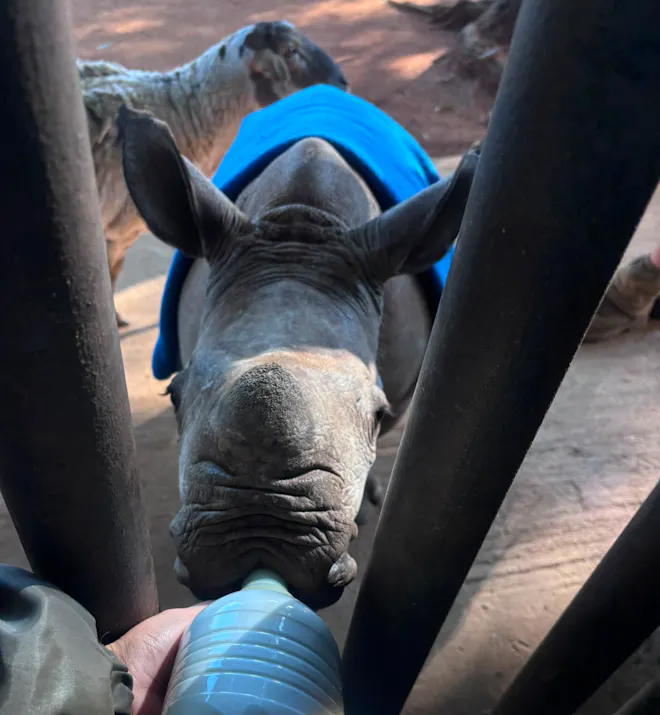
A good chunk of time each day was spent feeding the youngest rhino, as they needed feeding four times a day. As there were four volunteers on the project during my stay, we each had a turn feeding the baby every day. I would make the milk following the correct measurements of formula and other ingredients, and then bottle-feed the baby myself! She was a very, very greedy baby.
Every day, we cleaned the animal enclosures of the goats, pigs, owls and the baby rhino. This consisted of sweeping up hay from the day before and scrubbing the floors with clean water to get rid of any lingering dirt, as well as scrubbing the owl’s perches with disinfectant water.
Despite the whole experience at the orphanage being completely life-changing and memorable, the memory I’ll think about the most is probably seeing a baby rhino for the first time.
The baby in the surrounding reserve was around a week old when I arrived at Golola, and there were only two or three sightings by a few members of staff at this point. One day, we were doing the afternoon feed out in the bush, and we had spotted a lone rhino who we figured was the mother of this baby. We were very excited and hoped to see her baby, and then he popped out from the bush running beside her!
It was such a surreal experience being able to see a mother and her child roam freely in the reserve. After watching countless documentaries about poaching and the devastating effects of the rhino horn trade, it was incredible and quite emotional to see the continuity and persistence of such an amazing species.
What was also really special about this moment was the sheer excitement and awe from the two staff members who came on the drive. From this point on, the mother and her baby boy made an appearance every day, excited and running over to us on the back of the truck!
I don’t think I can even put into words how much this experience has impacted me.
I often felt desensitised yet frustrated at the sight of continuous poaching awareness documentaries and adverts on the TV, confused as to what I was meant to do about the crisis. I had done thorough research about the poaching catastrophe in South Africa but often felt lost, wondering what I could personally do to provide the slightest bit of help to such a beautiful species. I then found ACE after researching different volunteering programs focusing on rhinos.
As soon as I got to the orphanage and met the staff and listened to their stories and reasons for working here, I was instantly inspired by their courage and selflessness towards the protection of the rhinos.
To be up close with the rhinos, separated by only a few inches, I was hit with the harsh realisation of the severity of the poaching crisis. To see these animals up close in their natural habitat, not through a murky zoo window, and to look into their eyes, I wondered how some humans could be so heartless and cruel. To think that rhinos have lived for over 50 million years but are nearly extinct solely due to the greed of humans has really affected me.
As well as this, the staff shared each rhino’s story so passionately and intricately, which further embedded the sadness and horror of the rhino horn trade. I learned about how one of the rhinos at the orphanage was injured by the bullet that killed her mum, and how she has permanent blindness due to a tight blindfold.
To understand the psychological and emotional effect it has on the rhinos, the PTSD, depression and heartbreak they feel at such loss was truly devastating. The staff really had a way with their words when explaining these stories; I would have never known how deeply these animals feel if it weren’t for them. The act of knowing, alone, has changed me forever.
To develop a brief bond with each and every rhino and to see their individual personalities and playful characteristics on a daily basis also deeply impacted me. But most of all, the motherly instinct of the rhinos with their babies really stuck with me.
Despite only being at the orphanage for a week, the experience, the lessons I have learnt, and the little bit of help I put into fighting the war against rhino poaching will last a lifetime.
My experience at the orphanage exposed me not only to the beautiful parts of seeing the rhinos in the wild, but also to the ongoing devastation they face that is ever so prominent today. To understand that I have helped feed mothers and their babies in the wild, as well as feeding the camp rhinos and the baby orphan, is a feeling that I will cherish forever.
I would tell anyone remotely interested in volunteering to jump at the chance to do this project because they won’t regret it. I’d explain how life-changing the overall experience was and how surreal it was to work with such a beautiful species every day. I’m already planning to come back here next year!


Feeling inspired by Casey Sims's experience?
Learn more about our Wildlife Travel Experiences
Stories, tips, recommendations – they’re the glue that binds our community together. So if you’re planning your trip, why not hear what previous travellers have to say?